
The Early-Career Experience in a nutshell
How does work work?
Early career is the moment when someone goes from studying work to living work.
And most of the time, the questions that show up are painfully practical:
- •“How do I feel and develop as a person at work?”
- •“What are the rules of the game?”
- •“How can I see opportunity in and for my organisation?”
- •“And who can I talk to about all that?!”
A real early-career experience (ECE) is the system that helps answer those questions.
Why is an early-career experience important
A strong ECE is not just a nice-to-have, but a system that has four concrete outcomes:
1️⃣ Retention & workforce stability
The ECE improves retention and workforce stability by creating structured touch points with peers, colleagues and the organisation at large. That way, young talent, often new to an organisation, can connect more easily with their colleagues, strengthening their sense of belonging.
2️⃣ Speed to productivity
The ECE focuses on clear expectations, structured learning, and tight feedback loops, so young talent understands quickly what success looks like and who to ask in case of questions. Such structures help them to contribute fast.
3️⃣ Internal mobility & talent pipeline
A deliberate ECE helps young talent understand and build skills, reputation, and networks that create transparency and support their progression within the organisation.
4️⃣ Well-being and long-term sustainability
Early career is a high-risk phase for unhealthy patterns. A good ECE helps young talent build healthy routines that prevent exhaustion and burnout in the long-term.
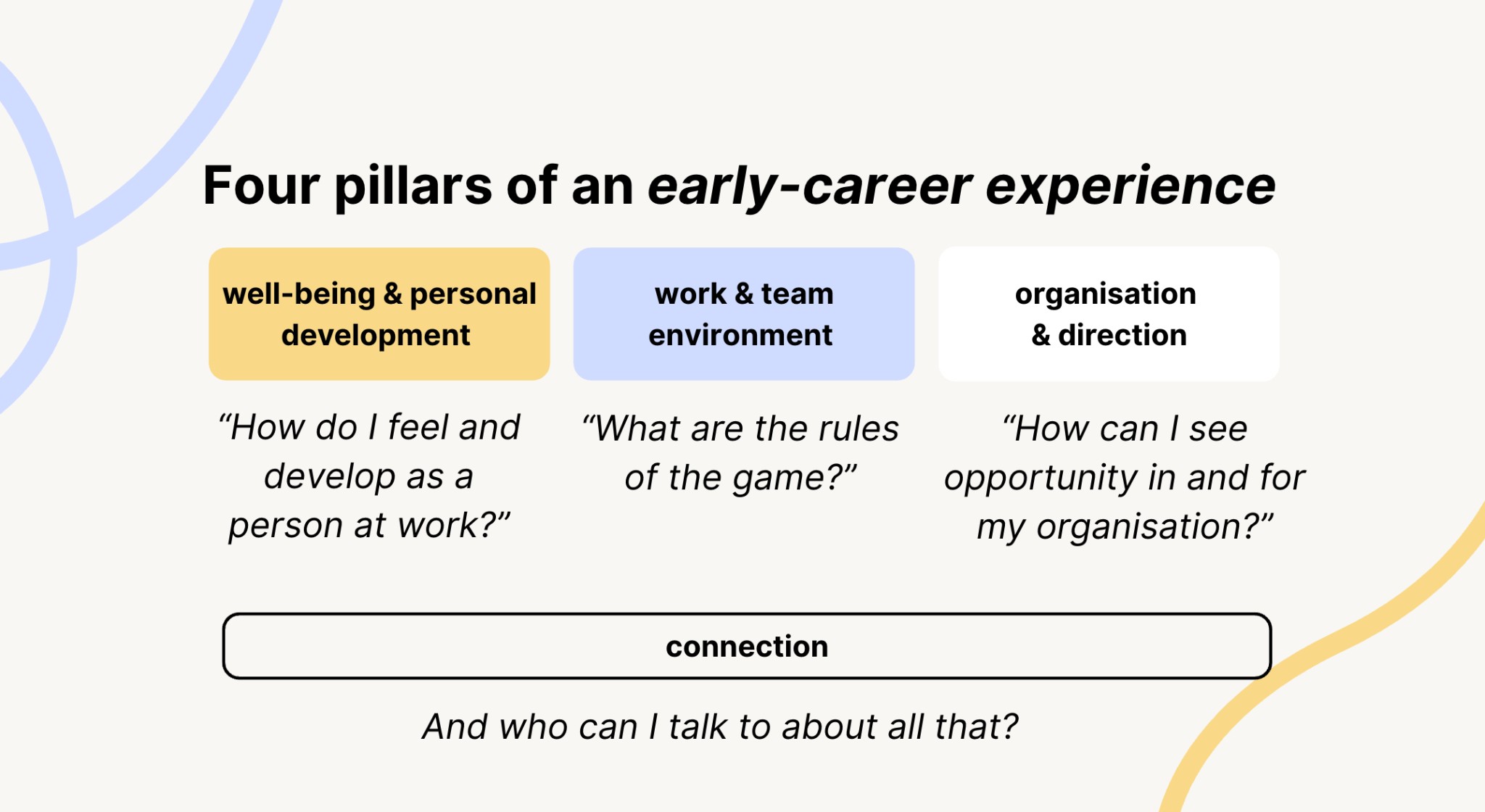
The pillars of an early-career experience
Pillar 1: Well-being & personal development
This pillar is focused on strengthening young professionals from the inside out. Giving them the space to understand themselves and learn how to effectively self-reflect becomes a priority.
This pillar centres around answering the question: “How do I feel and develop as a person at work?”
Topics within this pillar include:
- •Identity, fit, and motivation (what matters to me, what I’m good at, what environments help me thrive)
- •Self-regulation and work habits (routines, self-management, staying reliable under pressure)
- •Wellbeing and boundary management (recovery, stress, protecting energy so work stays sustainable)
Pillar 2: Work & team environment
This pillar zooms out slightly. From “me” to “my team”. Here, empathising with colleagues, understanding team dynamics and learning the rules of the game are essential. It helps young professionals to build strong relationships and become effective team members.
This pillar centres around answering the question: “What are the rules of the game?”
Topics within this pillar include:
- •Interpersonal effectiveness and communication (collaborate smoothly, build trust, communicate clearly)
- •Learning, feedback, and skill development (practice on the job, use feedback well, build confidence through real work)
- •Team-level organisational socialisation (learning “what good looks like,” team norms, and “how to get things done here”)
Pillar 3: Organisation & direction
And we zoom out even further. From “my team” to “the organisation and systems”. Understanding direction, organisational structure and what this means for the day-to-day of young professionals, find space here.
This pillar centres around answering the question: “How can I see opportunity in and for my organisation?”
Topics within this pillar include:
- •System-level socialisation (understanding how decisions are made, how performance is judged, and which structures/networks shape the role)
Pillar 4: Connection
The fourth pillar answers the human question underneath all the others: “Who can I talk to about all that?”
A strong ECE connects the young professional to peers, colleagues, leadership and coaches. That way, the ECE ensures a diverse exchange of perspectives and angles.
What young professionals experience when the early-career experience is strong
When the ECE is working, you will hear young talent say things like:
- •“I understand how work works.”
- •“I ask for help.”
- •“I learn quickly.”
- •“I am productive.”
- •“I am connected to my colleagues.”
- •“I want to grow within the organisation.”
- •“I am healthy and resilient.”
That’s the lived experience of a system that makes work legible, builds confidence through real practice, and normalises support.
What’s needed operationally to set one up
Overall, a strong ECE has the following operational building blocks:
- Program: the “what” and the journey architecture
- Project management: the “how it runs”
- Facilitation: the “container” that creates psychological safety + learning
- Touch points: the “network effect” that creates a connection
- Coaching: the personalisation layer
At Young Heroes, we have all these building blocks ready to go and can support your early-career experience tomorrow.
Interested in discussing what an ECE could look like for your organisation?
Book 30 min with us and we’ll think along!